
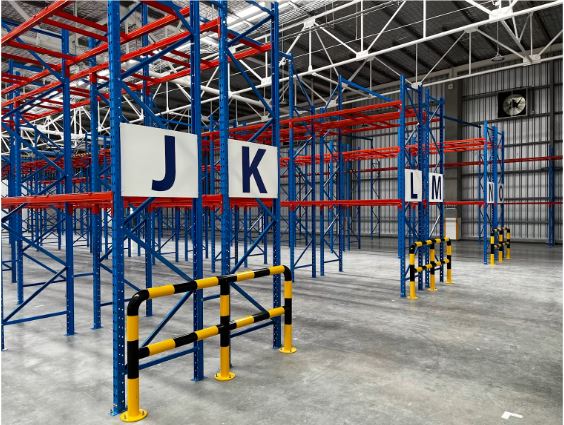


When a business starts growing fast, the immediate focus is usually on buying more stock, hiring more staff, or expanding the delivery fleet. But the physical space where everything is stored often gets ignored until it is too late. Squeezing more inventory into an outdated layout is an easy way to create a costly bottleneck, slowing down your pickers and putting extra strain on your team. It also introduces major safety blind spots, where cramped aisles lead to accidental frame impacts that can compromise your compliance before you even schedule professional pallet racking safety inspections.
To build a warehouse layout that actually supports your growth over the next five to ten years, you have to look past your current stock levels. It is about balancing the physical space you have today with the speed and safety requirements of tomorrow.
Balancing Storage Density with Daily Picking Speed
A common mistake when space gets tight is trying to pack as many pallets onto the floor as possible. It is easy to see why managers opt for high-density setups like drive-in racking. But if your team has to move three pallets out of the way just to access the one they actually need, you have traded picking speed for storage space.
Before changing your layout, take a close look at your projected stock-keeping unit (SKU) profiles:
- High-turnover, diverse stock: If your future growth is driven by e-commerce or rapid, multi-category retail where you need to get to individual items quickly, maintaining direct access to every single pallet is crucial. Selective racking or narrow-aisle setups are far better suited to keep these fast-moving picking cycles on track.
- Bulk, identical items: If your expansion is based on storing large batches of identical products, high-density systems like push-back or automated pallet runners will give you a much better return on your floor space without hurting your efficiency.
A practical layout often leaves room for modular changes, allowing you to transition from simple selective setups to semi-automated systems as your inventory volume grows.
Calculating Real-World Physical and Mechanical Tolerances
A warehouse design is only as good as the machinery operating inside it. If you narrow the aisles to fit in two extra rows of racking, but your existing forklift fleet cannot turn around safely without scraping the uprights, you are going to run into immediate operational issues. Drivers have to slow down to avoid collisions, which hurts your daily output, increases driver fatigue, and makes structural damage almost inevitable.
You also need to think about what your concrete floor slab can handle. As you build racking structures higher to make use of your vertical space, the physical weight concentrated on the frame feet increases dramatically. Verifying these load limits early prevents concrete cracking and structural settling issues that are incredibly expensive to fix once the racks are loaded.
Protecting Your Storage Steel and Staying Compliant
When your business scales and daily throughput intensifies, your physical steel frames bear a much heavier daily burden. Forklifts are moving faster, turnaround times are shorter, and heavy loads are constantly being shifted.
Small, unnoticed impacts from machinery can slowly compromise the structural integrity of your setup. It is easy to overlook a slightly bent frame or a missing safety pin, but these minor issues build up over time. Keeping the workplace safe is not just about common sense; it is a strict legal requirement.
In Australia, under AS4084 standards, static steel storage systems must undergo a formal check at least once every 12 months. Setting up regular, scheduled safety audits with a qualified independent inspector is the best way to identify structural weaknesses before they develop into a major risk. For high-volume, 24/7 distribution hubs where the risk of forklift strikes is much higher, shifting to a six-monthly or quarterly audit cycle is highly practical.
Investing in protective accessories, such as heavy-duty steel column guards and end-of-row barrier rails, provides a vital physical buffer. These simple additions absorb the daily knocks of busy machinery, protecting your uprights and ensuring your warehouse remains secure and compliant as your business expands.